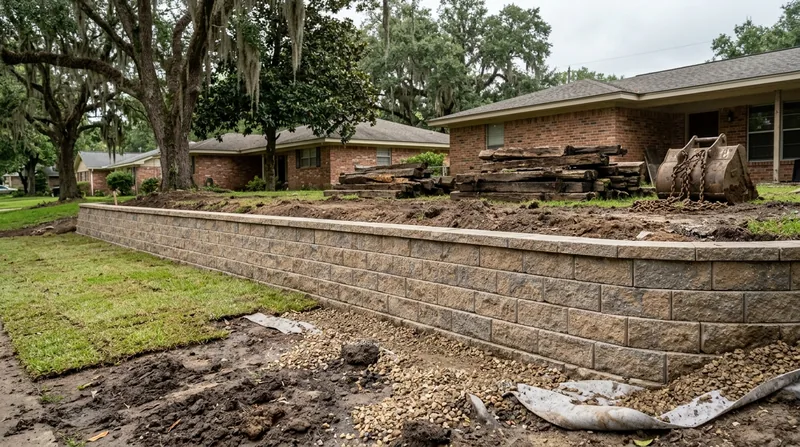




Retaining Wall Replacement in Baton Rouge
Baton Rouge sits on the first bluff above the Mississippi, where the ground drops from the old terrace along Highland Road into bottomland laced with Bayou Fountain, Ward Creek, and Dawson Creek. That drop is why so many properties here need a Retaining Wall Replacement in Baton Rouge: walls built decades ago are now leaning, bulging, or rotting out. The gumbo clay under this city swells hard after a wet spring and shrinks in a dry summer, and it pushes old walls out of line year after year. We tear out failed walls, haul off the debris, and rebuild with modern materials and real drainage. If your wall is still standing but cracked or bowed, a retaining wall repair may save it. If it is past saving, replacement is the honest answer.
Why Failed Walls Are So Common in Baton Rouge Clay and Bayou Country
Most of the walls we replace were never built for this soil. Railroad tie and landscape timber walls from the 1970s and 1980s are eaten through by Formosan termites, and the ones that survive the bugs heave and sag as the clay moves. Poured concrete and old brick walls crack because they have no drainage behind them and no room to flex. On bluff and bayou-bank lots off Highland Road, the slope itself is working against the wall.
- Formosan termites hollow out railroad tie walls until the ties crumble in your hand.
- Expansive gumbo clay swells in wet weather and shrinks in drought, racking the wall face.
- Heavy subtropical downpours and hurricane rain like Gustav and Ida saturate backfill faster than old walls can drain it.
- Tree roots from live oaks, magnolias, and cypress lift footings and pry wall courses apart.
- Walls holding raised slabs, driveway grades, and pool decks in Southdowns and Sherwood Forest carry a surcharge the original builder never designed for.
When a wall is leaning past a few inches or the face is bulging, replacement usually costs less than patching it twice.
Key info: In Capital Heights and the Garden District, we routinely pull out 1940s brick garden walls that were built without weep holes. The brick is sound, but the footing is gone and the clay has pushed the whole face forward.
Before you schedule anything, check the permit rules with the City of Baton Rouge and East Baton Rouge Parish building department. Many jurisdictions require a permit for walls above roughly 4 feet measured from the footing, or when the wall supports a surcharge such as a driveway or structure.
How We Replace a Wall in Baton Rouge, Step by Step
Replacement is not a patch job. We take the old wall out completely, including the buried courses and the failed footing, then rebuild from the ground up. The work starts with reading the slope and the soil, because a wall on a bayou bank in Shenandoah needs different engineering than a low garden wall in Beauregard Town.
- We walk the site and mark utilities before any digging starts.
- We demolish the old wall and haul away every tie, block, and chunk of concrete.
- We excavate to a stable base and set a new compacted gravel footing.
- We install drainage stone, filter fabric, and perforated pipe so water never builds up behind the new wall.
- We build the new wall with engineered segmental block, poured concrete, or natural stone suited to the load and the slope.
- We backfill in lifts, compact each one, and finish the grade so runoff moves away from the wall.
Every replacement ends with a wall that drains, sits on a proper footing, and matches the grade around it.
Key info: On a terraced lot off Highland Road near the University Lakes, we replaced a collapsed timber wall with segmental block and a full drainage system. The old wall had no gravel and no pipe, so every rain storm loaded the clay behind it until it let go.
If you are weighing materials, compare our block and segmental retaining walls with poured concrete before you decide.
Replacement Approaches We Use in Baton Rouge
| Approach | Description | Best for |
|---|---|---|
| Segmental block replacement | Engineered SRW block on a compacted gravel base with drainage stone and pipe behind the wall. | Terraced yards, driveway grades, and pool decks on clay lots. |
| Poured concrete replacement | Steel-reinforced concrete wall with proper footing and weep drainage. | Tall walls and walls carrying a structural surcharge. |
| Boulder and natural stone | Rock wall rebuilt with free-draining backfill and no mortar joints to crack. | Bayou-bank lots and slopes where a natural look fits. |
| Timber and tie tear-out | Full removal of termite-eaten ties and timbers, then rebuild in modern material. | Older yards in Broadmoor, Kenilworth, and Central. |
| Slope stabilization rebuild | Wall replacement combined with regrading and erosion control on steep ground. | Bluff lots and banks where the slope itself is failing. |
Retaining Wall Replacement Cost in Baton Rouge: What to Expect
Most replacements here start from $35 per square foot of wall face, and the final number depends on how much wall you have and what is behind it. A low garden wall in Inniswold is a different job than a tall wall holding a driveway in Shenandoah. Removal and haul-away of the old wall, footing depth, drainage, and access all move the price.
The biggest cost drivers we see are access for equipment, the height and length of the wall, whether the old footing has to be broken out, and whether the wall carries a surcharge. Tight side yards, pool decks, and walls under mature live oaks take longer and cost more to work around.
Get two or three written estimates and compare what each one includes: drainage, backfill, compaction, and disposal are where cheap bids cut corners. Our full pricing overview breaks down the line items so you can compare apples to apples.
What to Look For When Hiring a Retaining Wall Contractor Near Baton Rouge
Ask for proof of insurance before anyone touches your wall, and get it in writing. Confirm the contractor carries general liability and workers compensation, and ask for a certificate. Get at least three estimates, and check references from jobs done at least two years ago so you can see how the wall is holding up.
Ask who pulls the permit and whether engineered drawings are needed for a tall or tiered wall. If your property sits near a protected tree or falls under HOA rules, confirm the contractor has handled those approvals before. Our contact page is the place to start a free estimate.
We are fully insured, and we hold NCMA Segmental Retaining Wall Installer Certification. We will show you the certificate on request.
Retaining Wall Replacement in Baton Rouge: Pricing Guide
| Service | Price | Details |
|---|---|---|
| Low garden wall replacement | Starting at $35/sq ft | Includes tear-out, haul-away, new footing, block, and drainage; height and access move the price. |
| Driveway or pool deck wall | Starting at $48/sq ft | Includes surcharge-rated block and reinforced footing; engineering and tight access raise the cost. |
| Timber and railroad tie tear-out | Starting at $40/sq ft | Includes full removal of termite-eaten ties, disposal, and rebuild in modern material. |
| Tall or tiered engineered wall | On estimate | Needs an on-site look for footing depth, soil, surcharge, and permit drawings before pricing. |
| Travel | Included | In Baton Rouge and surrounding areas, no separate call-out or mileage fee. |
| Estimate | Free | Response within 24h at (225) 416-8270, no obligation to book. |
Indicative pricing, the exact cost depends on square footage, finish, and site access. Free personalized estimate within 24h at (225) 416-8270.


