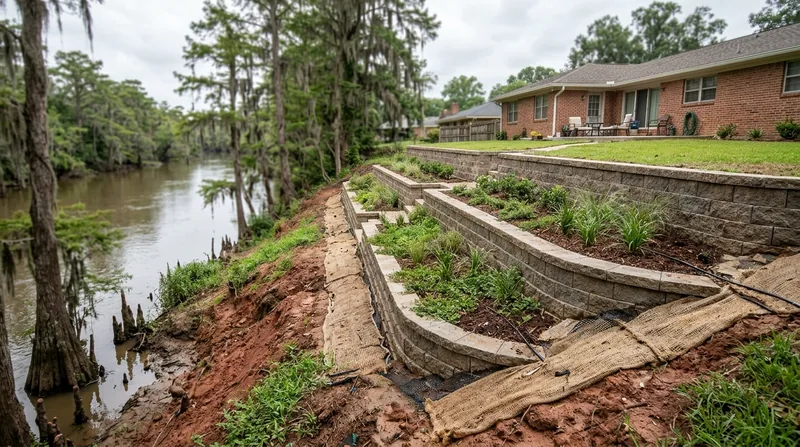




Baton Rouge sits on the first bluff above the Mississippi River, where the ground drops from the old terrace along Highland Road into bottomland threaded with Bayou Fountain, Ward Creek, Dawson Creek and Bayou Manchac. That drop is where most slope trouble starts. Heavy subtropical downpours soak the expansive gumbo clay until it swells, then drought shrinks it and opens cracks, and the next storm sends the whole face sliding. If you are searching for slope stabilization and erosion control in Baton Rouge, you are usually watching soil creep toward a slab, a pool deck or a bayou bank. We build terraced walls, geogrid reinforcement and drainage that hold that ground where it belongs. Start with a look at our retaining wall installation work to see how a properly built wall ties into a slope.
Why Slope Stabilization and Erosion Control Matters on Baton Rouge Bluffs and Bayou Banks
The failure mode that dominates here is not rockfall or frost heave. It is saturated clay losing its grip after a 3-inch rain, combined with a high water table that keeps the lower soils soft all year. Add live oaks and magnolias pumping water out of the upper bank and you get tension cracks, bulging toes and driveway slabs that drop an inch a season. Walls above 4 feet or walls carrying a surcharge usually need a permit, and the East Baton Rouge Parish building department is the authority to verify thresholds with.
- Water ponds behind old walls because the original builder skipped gravel and drain pipe, and hydrostatic pressure pushes the face out of line.
- Formosan termites hollow out timber and railroad tie walls until the slope has nothing left holding it.
- Bayou Fountain and Ward Creek banks undercut during high water, and the top edge slumps toward the channel.
- Expansive clay shrinks in summer drought and cracks pool decks and patios built too close to the slope crest.
- Downspouts and driveway runoff dump concentrated flow onto bare banks and carve gullies in one season.
Every one of those problems gets worse with time, and the cheap fix today is the expensive repair next spring.
Key info: After the August 2016 floods, homeowners along Bayou Fountain and the Comite River found that banks which had looked fine for decades failed in a single event. If your lot backs onto a bayou or creek, have the bank inspected before the next tropical system, not after.
For official guidance on floodplain and grading rules, the parish and city permit offices are the source to check: City of Baton Rouge and East Baton Rouge Parish.
How We Stabilize a Baton Rouge Slope, Step by Step
We start by reading the water, not the wall. On a Highland Road terrace lot or a Shenandoah backyard that drains to a creek, the question is where stormwater enters, where it ponds and where it leaves. Then we design the fix around the actual soil, the slope angle and whatever sits uphill, whether that is a pool, a slab or a 100-year-old live oak.
- We walk the slope and mark the tension cracks, wet spots and any movement at the toe.
- We dig test holes to see how deep the clay is soft and where the water table sits.
- We regrade the crest where possible to shed water away from the wall and the foundation.
- We install drainage, gravel and filter fabric so water exits instead of pushing.
- We build the wall in lifts, adding geogrid reinforcement back into the slope as we go.
- We seed, sod or armor the bare face so rain does not restart the erosion.
That sequence is what separates a wall that lasts 30 years from one that leans in three.
Key info: A Central homeowner had a 5-foot bank behind the house washing out every storm. We terraced it with two short segmental block walls, added geogrid and a French drain at the toe, and redirected two downspouts. The bank has held through every heavy rain since, and the backyard is usable again.
If the slope sits near a bayou or the lakes, check our retaining wall drainage page for how we handle high water tables.
Stabilization Methods We Use in Baton Rouge
No single method fits every lot. A bluff-edge yard off Highland Road needs different treatment than a flat slab home in Shenandoah with a drainage ditch at the property line. Here is how the main approaches compare.
| Approach | Description | Best for |
|---|---|---|
| Terraced segmental block walls | Two or more short walls stepped up the slope, each with geogrid and drainage. | Bluff and bayou-bank lots with a long, steep drop. |
| Geogrid-reinforced slope | Layers of grid buried in compacted lifts tie the soil mass together. | Slopes too gentle for a tall wall but still sliding. |
| Surface erosion control | Sod, riprap, erosion matting and downspout extensions to stop gullying. | Bare banks and new construction where water runs fast. |
| Boulder and riprap toe protection | Heavy stone at the base to absorb wave and current energy. | Creek and bayou banks that undercut during high water. |
| Drainage correction | French drains, gravel trenches and surface swales to move water off the slope. | Wet spots, ponding and walls already showing pressure. |
We choose the method after we see the water path, not before.
Slope Stabilization and Erosion Control Cost in Baton Rouge: What to Expect
We start every project with a free estimate, and that is the only honest starting point because slope work is priced by the site, not by the square foot. A short bank behind a Zachary ranch house with easy access is a different job from a steep Highland Road bluff lot where a mini-excavator cannot reach the toe. Expect the number to move with height and length of slope, soil conditions, how much drainage is needed, and whether an engineer must sign off on a tall or tiered wall.
Access is the biggest swing factor. A wall you can reach with a machine and a truck costs less than one built by hand down a 30-foot bank behind a pool. Permit requirements and engineered drawings add cost on walls above the parish threshold or walls carrying a driveway. Getting two or three estimates is smart because you will see how each contractor reads the same slope, and the cheapest bid often skips the drainage that keeps the wall standing. See our pricing overview for the full range before you call.
What to Look for When Hiring a Retaining Wall Contractor Near Baton Rouge
Hiring for slope work near Baton Rouge means hiring someone who understands expansive clay and high water tables, not just someone who can stack block. Ask how they handle drainage, because a wall without a drainage plan is a wall on a countdown. Ask for references on jobs with similar slope and access, and call them.
- Confirm the contractor is fully insured and ask for a certificate before work begins.
- Get at least two or three written estimates that separate labor, materials and drainage.
- Check references on projects with the same slope height and soil conditions as yours.
- Ask who pulls the permit and whether engineered drawings are required for your wall height.
- Read your HOA rules before you sign, since some subdivisions restrict wall height and material.
If a bidder cannot explain how water leaves the slope, keep looking. Reach us through the contact page to schedule a free walkthrough.
Slope Stabilization & Erosion Control in Baton Rouge: Pricing Guide
| Service | Price | Details |
|---|---|---|
| Slope inspection and stabilization plan | Free estimate | On-site walk of the slope, drainage check and written recommendation before any work begins |
| Surface erosion control and regrading | Starting at $1,200 | Regrading, sod or matting and downspout extensions on short accessible banks |
| Segmental block terrace or reinforced slope | Starting at $45 per square foot of wall face | Includes geogrid, gravel backfill and drain pipe, price rises with wall height and access |
| Boulder or riprap bank protection | On estimate | Creek and bayou banks need an on-site look at undercut depth and machine access |
| Complex or engineered slope job | On estimate | Tall or tiered walls with a surcharge need engineered drawings and a site visit to price |
| Travel | Included | in Baton Rouge and surrounding areas, no separate call-out or mileage fee |
| Estimate | Free | Response within 24h at (225) 416-8270, no obligation to book |
Indicative pricing, the exact cost depends on square footage, finish, and site access. Free personalized estimate within 24h at (225) 416-8270.


