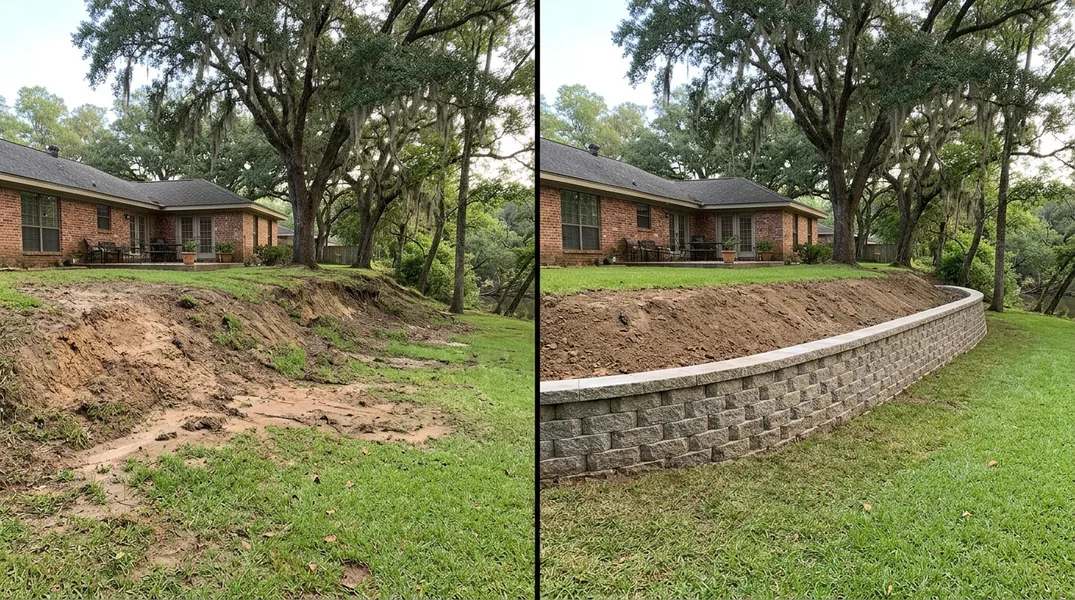
Why Louisiana's Clay Soil and Storm Season Demand the Right Material
If you live in Baton Rouge, you already know that the ground beneath your feet is not like the sandy or rocky soils you see in other parts of the country. Much of the region sits on expansive clay that swells dramatically when it absorbs water and shrinks just as aggressively when it dries out. That constant cycle of expansion and contraction puts enormous lateral pressure on any retaining structure, and it is the single biggest reason why a wall that works beautifully in another state can fail here within a few seasons.
Layer hurricane season on top of that. From June through November, Baton Rouge can receive torrential rainfall in short bursts, and the clay soil drains slowly. Water builds up behind a wall, saturates the backfill, and adds hydrostatic pressure that many homeowners never anticipate. A retaining wall here has to do two jobs at once: hold back heavy, shifting earth and manage water that has nowhere to go. Choosing the right material is the foundation of getting both jobs done, and it is why local knowledge matters so much when you plan a project.
Concrete Retaining Walls: The Heavyweight Champion for Stability
When homeowners ask which material offers the most raw strength and longevity in south Louisiana, Concrete Retaining Walls are usually the first answer. Poured concrete is massive, monolithic, and highly resistant to the lateral forces that expansive clay generates. Because it is cast as a single continuous structure (or in large engineered sections), it does not shift piece by piece the way stacked materials can. It also stands up well to moisture, which matters enormously during hurricane season when a wall may be saturated for days.
Concrete is particularly well suited to taller walls, steep grade changes, and situations where a homeowner wants a clean, modern look that will not need much maintenance. It can be stamped, textured, or colored to soften its appearance, so it does not have to look like a bare highway barrier. The tradeoff is that proper concrete work requires careful engineering, correct footing depth, and reliable drainage, which is why this is not a do-it-yourself material. For a wall that must perform for decades in Central or anywhere across the parish, concrete remains one of the most dependable choices available.
Block and Segmental Retaining Walls: Flexibility That Handles Clay Movement
A block retaining wall built from interlocking segmental units has become one of the most popular choices for residential projects, and for good reason. Segmental blocks are designed to flex slightly as the ground moves, which is a real advantage in clay that never stops shifting. Instead of cracking under stress, a well-built segmental system distributes pressure across many units and can accommodate minor settlement without catastrophic failure. Modern segmental blocks also come in a wide range of colors and textures, so you can achieve a natural stone look or a more tailored appearance.
The key phrase is well built. A Retaining Wall Installation using segmental block depends on proper base preparation, correct compaction of the leveling pad, and geogrid reinforcement for taller walls. In Louisiana clay, drainage is non-negotiable: gravel backfill and a perforated drain pipe must channel water away from the wall. When those details are handled correctly, a segmental retaining wall can deliver excellent performance and a handsome finished look at a reasonable price point. When they are skipped, even premium blocks will fail.
Limestone Retaining Walls: A Natural Look With Local Practicality
A limestone retaining wall brings a warm, natural aesthetic that many homeowners in the region love, and limestone has practical advantages too. It is dense, heavy, and highly resistant to water damage, which makes it a sensible option in a climate that delivers heavy rain. Limestone is also naturally alkaline, and some studies suggest it can help buffer soil acidity over time. For garden walls, terraced beds, and low to medium-height retaining structures, limestone offers a timeless look that fits beautifully with Southern landscaping.
It is important to be realistic about how limestone performs in a structural role. Natural stone walls rely on gravity and careful stacking, and in expansive clay they need generous base preparation and drainage just like any other system. Limestone is best used for walls under a certain height or in combination with proper reinforcement and engineering. A reputable installer will assess your slope, soil conditions, and drainage before recommending limestone, and will be honest if a different material is a better fit for the loads involved. Used correctly, it is one of the most attractive and durable options available.
Retaining Wall Installation Near Me: Matching Material to Your Property
Searching for retaining wall installation near me in the Baker or Baton Rouge area usually means you have a specific problem to solve: a sloped yard that is eroding, a driveway that is settling, or a patio that needs more usable level ground. The right material depends on the height of the wall, the load it must carry, how much water passes through the site, and the look you want. A short garden terrace and a tall structural wall holding up a driveway are entirely different engineering problems, even if they sit on neighboring lots.
That is why a site visit matters more than a catalog. A professional will examine your soil, measure the slope, check where water flows during a storm, and consider access for equipment. From there, they can recommend concrete, block, limestone, or a segmental system with confidence. If you already have a wall that is leaning, cracking, or washing out, Retaining Wall Repair may be possible, though some walls are better replaced than patched. Either way, an honest assessment saves you money over the long run. You can request a free estimate to get the conversation started.
Retaining Wall Installation Cost in Baton Rouge: What to Budget
Homeowners understandably want to know what a project will run before they commit. Retaining wall pricing in Baton Rouge depends on several variables: the height and length of the wall, the material selected, the amount of excavation required, soil conditions, drainage needs, and whether engineering or permits are involved. A low garden wall of segmental block is a very different investment from a tall engineered concrete wall holding back a steep slope. Material costs also vary, with natural limestone and specialty concrete finishes generally commanding more than standard block.
Rather than quoting a single number that will not apply to your property, a reputable contractor will walk the site and provide a detailed estimate that explains what you are paying for. Be cautious of unusually low bids, because in this region the cheapest quote often means skipped drainage, shallow footings, or no reinforcement, all of which lead to expensive failures during the next heavy storm. If a wall is beyond saving, Retaining Wall Replacement is sometimes the more economical path once repair costs are weighed. Call Baton Rouge Retaining Wall at (225) 416-8270 to discuss your project and get a clear, no-pressure estimate.
Looking for a professional retaining wall contractor in Baton Rouge? Baton Rouge Retaining Wall responds fast for all your retaining wall needs.
Get a Free QuoteOur services: Retaining Wall Installation · Retaining Wall Repair · Retaining Wall Replacement