Why Baton Rouge Downpours Are So Hard on Retaining Walls
If you live in Baton Rouge, you already know how intense our summer storms can be. A single afternoon thunderstorm can drop several inches of rain in less than an hour, and that water has to go somewhere. When a retaining wall holds back a slope, all of that rainwater soaks into the soil behind the wall. If the wall was not built with proper drainage, the water has nowhere to escape, and the problems begin almost immediately.
This is not a cosmetic issue. Water is the number one enemy of any retaining wall, and in a climate like ours, a wall without adequate drainage is essentially a wall waiting to fail. Homeowners in Zachary and Central face the same conditions, because the entire region shares the same heavy rainfall patterns and clay-heavy soils. Understanding how drainage works, and what happens when it fails, is the first step toward protecting your investment.
Hydrostatic Pressure: The Invisible Force That Topples Walls
When water saturates the soil behind a retaining wall and cannot drain away, it creates what engineers call hydrostatic pressure. Think of it as water pushing against the back of your wall with tremendous force, like a water balloon pressed against a screen door. The more water that accumulates, the greater the pressure. Over time, this pressure can cause the wall to bulge, crack, lean forward, or even collapse entirely. For a homeowner, the first sign is often a wall that looks slightly out of plumb or mortar joints that begin to crack.
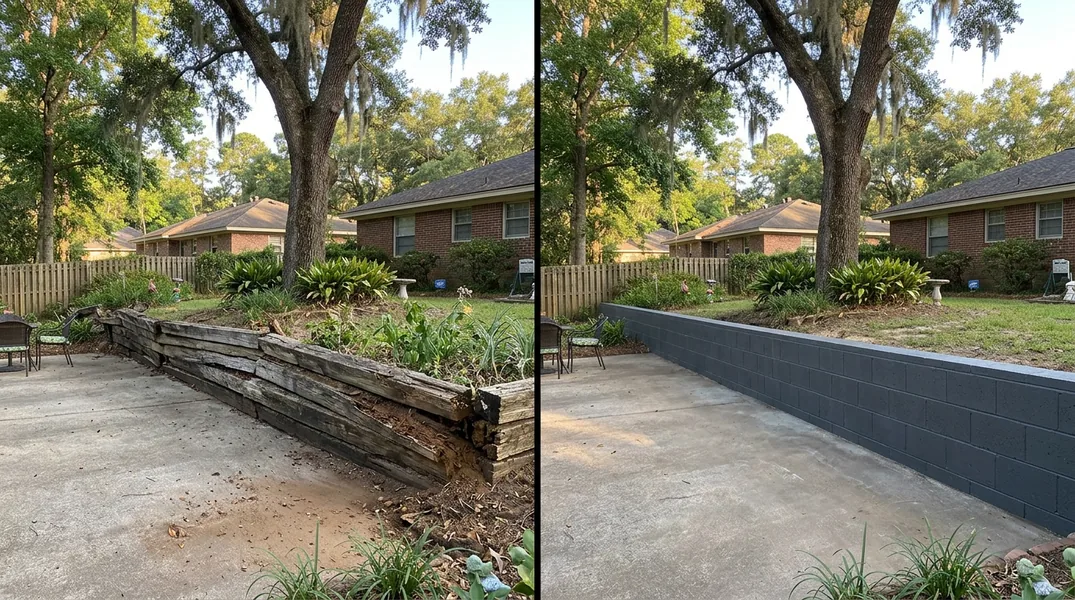
Hydrostatic pressure retaining wall failures are especially common in older walls that were built without a proper drainage system. Many older walls in Baton Rouge were constructed with solid backfill and no gravel, no drain pipe, and no weep holes. During a downpour, the soil behind the wall becomes heavy and saturated, and the wall simply cannot hold it back. If you are seeing signs of movement or cracking, it is worth calling a professional for Retaining Wall Repair before the next storm season arrives.
How a Retaining Wall French Drain Prevents Costly Failures
The most effective defense against hydrostatic pressure is a retaining wall french drain. This system typically consists of a perforated pipe wrapped in filter fabric and surrounded by washed gravel, installed at the base of the wall behind the backfill. When rainwater enters the soil, it flows through the gravel, into the perforated pipe, and is directed away from the wall to a safe discharge point. This simple but critical system relieves pressure before it can build up and damage the structure.
A proper french drain also includes a gravel backfill zone and, in many cases, a drainage board or geotextile fabric against the wall face to keep fine soil particles from clogging the system. Without these components, a drain pipe alone can silt up and stop working within a few years. If you are planning a new wall, make sure your contractor includes a complete drainage system, not just a pipe. If your existing wall lacks drainage, a retrofit may be possible, and our team can evaluate your options during a free estimate.
Signs Your Retaining Wall Drainage Is Already Failing
Drainage failure rarely happens overnight. In most cases, there are warning signs that appear weeks or months before a wall actually collapses. Look for water pooling at the base of the wall after rain, soil washing out from between wall blocks, or white mineral stains on the wall face. You may also notice that the wall has started to lean, that the capstones are shifting, or that weeds and vegetation are growing out of the wall joints. Any of these symptoms suggest that water is not moving through the system the way it should.
Another common sign is a soggy, spongy area behind the top of the wall, even days after a storm. That indicates the soil is holding water and the drain is not functioning. In some cases, the drain pipe may be clogged with roots, sediment, or collapsed sections. If you notice these issues, do not wait for the next heavy rain. A professional inspection can determine whether the wall can be repaired or whether Retaining Wall Replacement is the safer, more cost-effective option.
Retaining Wall Installation Near Me: Getting Drainage Right the First Time
The best way to avoid drainage problems is to have your wall designed and built correctly from the start. That means proper excavation, the right type of backfill, a correctly sloped grade behind the wall, and a drainage system sized for the amount of water your slope will receive. In Baton Rouge, where clay soils drain slowly, this is especially important. A wall that works fine in a drier climate can fail here if the drainage design is not adapted to our conditions.
When you search for Retaining Wall Installation near me, look for a contractor who talks openly about drainage, not just block style and color. Ask how they handle water behind the wall, whether they use a french drain, and what kind of gravel and filter fabric they install. If you are considering Concrete Retaining Walls, drainage is equally critical, and weep holes and footing drains must be part of the plan. For a clear look at what a properly drained wall should include, check our pricing page or call Baton Rouge Retaining Wall at (225) 416-8270 to schedule a consultation.
Protecting Your Wall Before the Next Storm Season
Baton Rouge weather is not going to get gentler, and the storms will keep coming. The good news is that drainage problems are preventable and, in many cases, repairable. If your wall is showing signs of water damage, or if you are planning a new wall and want to make sure it is built to last, the most important step is to work with a contractor who understands local soil and rainfall conditions. A wall that sheds water properly can last for decades, while a wall that traps water may fail in just a few seasons.
Do not wait until you see a collapse to take action. A professional assessment can identify drainage issues early and recommend the right fix, whether that is a new french drain, targeted repairs, or a full replacement. Call (225) 416-8270 or visit our free estimate page to get started. Serving homeowners in Baker and throughout the Baton Rouge area, our team is ready to help you protect your property from the next downpour.
Looking for a professional retaining wall contractor in Baton Rouge? Baton Rouge Retaining Wall responds fast for all your retaining wall needs.
Get a Free QuoteOur services: Retaining Wall Installation · Retaining Wall Repair · Retaining Wall Replacement